


Improving Quality of Care
The Center for Medicaid and CHIP Services (CMCS) Quality Improvement (QI) Program provides state Medicaid and Children’s Health Insurance Program (CHIP) agencies and their QI partners with the information, tools, and expert support needed to improve care and health outcomes, as demonstrated by performance on Medicaid and CHIP Child and Adult Core Set measures.
Technical assistance (TA), such as tools, access to subject matter experts, and opportunities for peer learning, are available to help states build QI knowledge and skills; develop QI projects; and implement, spread, and scale up QI initiatives.
QI Resources
The Model for Improvement is one of the best-tested and most-used approaches for health care improvement. We will use the term “improvement” to mean changes in activities or processes – potentially new or modifications to something existing – that has been tested, and results in achieving your goal.
You begin by answering three questions:
- What do you want to improve?
- What changes can you make that will result in improvement? and
- How will you know that your change is an improvement?
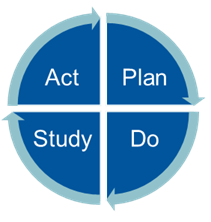
Drawn primarily from the Model for Improvement, the following worksheets and resources have been tested, modified, and used by state Medicaid and CHIP QI teams. They walk you through the four phases of QI projects, as shown in the figure below , and help you stay on track to accomplish the goal of your QI project.

Phase 1: Developing an Improvement
What would you like to improve, and how will you achieve improvement? Start by setting a goal, or aim, that includes what you want to accomplish, for whom, by how much, and by when. This will keep you focused on your goals throughout the life of your QI project. Next, explore what contributes to the current problem and what you can change. Many tools can help you better understand the problem you are trying to improve, including driver diagrams and process flows. Here is an example of a driver diagram for improving well-child visit rates and an example of a process flow in the Improving Timely Health Care for Children and Youth in Foster Care: Getting Started on Quality Improvement video.
After you define your aim, explore the problem, and consider potential changes, you are ready to decide whom to partner with on this project. QI can be challenging, and having a team that brings needed skills, expertise, and resources is key to success (see more on Additional Resources: Working with QI partners below). The following worksheets provide more guidance on creating your aim, understanding the problem, exploring potential improvements, and building your QI project team.
Phase 2: Testing an Improvement
QI requires change, but not all change is improvement. Testing is about learning and redesign, and ensuring that your changes are fit for purpose, can be sustained, and lead to improvement. The most efficient approach is to begin with quick, small tests and progress to bigger tests with varied circumstances until you are confident the change idea will lead to the improvement that will achieve your aim. Multiple small, concurrent tests will help you learn faster. One proven testing method for testing is to use Plan-Do-Study-Act (PDSA) cycles. The following worksheets provide more details on PDSA cycles and can help you develop PDSA tests for your QI project. To help illustrate the process, please watch the Advancing Oral Health Prevention in Primary Care: Getting Started on Quality Improvement video which walks you through the process of filling out a sample PDSA worksheet.
Using data and measures for QI will show you whether the changes you are making in your small tests are helping you achieve your goal. Measures for QI are different from measures for accountability (used to judge performance) or research (used to rigorously test and assess something in a controlled environment). Measures for QI can be imperfect and are meant to help you learn from the information gathered. They do not need to meet the detailed specifications required in measures for accountability or research. For example, it is acceptable to look at your quality measures before all the claims have been submitted; 1-2 months runout may be sufficient. For QI projects, you are looking for signs of progress, not perfection. Run charts are used to display your project data – on the y axis– over the time – on the x axis. Plotting the data over time will let you know whether the changes you are making are leading to improvement. To learn more about measures for QI and how to track them over time, refer to the following video and worksheets. Here is an example of a measurement strategy for improving well-child visit rates and an example of a run chart in the Improving Behavioral Health Follow-Up Care: Getting Started on Quality Improvement video.
Phase 3: Implementing and Sustaining an Improvement
Implementation is the process of moving a change idea out of a testing framework and into everyday practice to sustain that change over time. You will know you are ready for implementation when you have tested your change idea under various conditions (such as with different populations and locations) and see data showing consistent improvement over time (for example, your run charts show improvement). To successfully sustain your improvement, you must ensure that infrastructure, resources, and people are in place to support and continue your improvement as the “new normal.” The following worksheet will help you develop an implementation and sustainability approach for your QI project.
Phase 4: Spreading Improvement
“Spreading” means taking your improvement to new populations or new areas of your organization or system, including statewide for the Medicaid program. You will know you are ready to spread an improvement when staff have successfully implemented it in at least one system or site of care, the improvement has been sustained, and other QI partners are interested in making improvements. The Spreading QI worksheet will guide you through the steps to take improvements to new locations. The next section will help you put together the information you need to successfully reach out to QI partners to effectively spread your improvement.
Additional Resources: Working with QI Partners
QI requires partners. Partners are essential to understanding the problem, testing improvements, and testing and sustaining change. How do you identify whom to work with and what to ask of each partner? The following worksheets will help you find the right partners, craft a short message to help engage and inform them, and identify successful approaches to working with managed care plans.
Download the full compilation of QI worksheets.
Links to Additional QI TA
Additional QI TA on specific topics is available through the following links. You will find several examples of the QI tools previously described at these links.
• Improving Quality of Care | Medicaid
• Managed Care Quality Improvement | Medicaid
TA Requests
The Centers for Medicare & Medicaid Services (CMS) is available to provide individualized TA to your state. Please submit requests for TA related to Medicaid and CHIP QI to MedicaidCHIPQI@cms.hhs.gov.